Oracle Just Fired 30,000 People Before Breakfast. Is Your Job Next?
Oracle ended 30,000 careers with a five-line email at 6 a.m. No warning. No conversation. Here is what that morning means for your job in 2026.
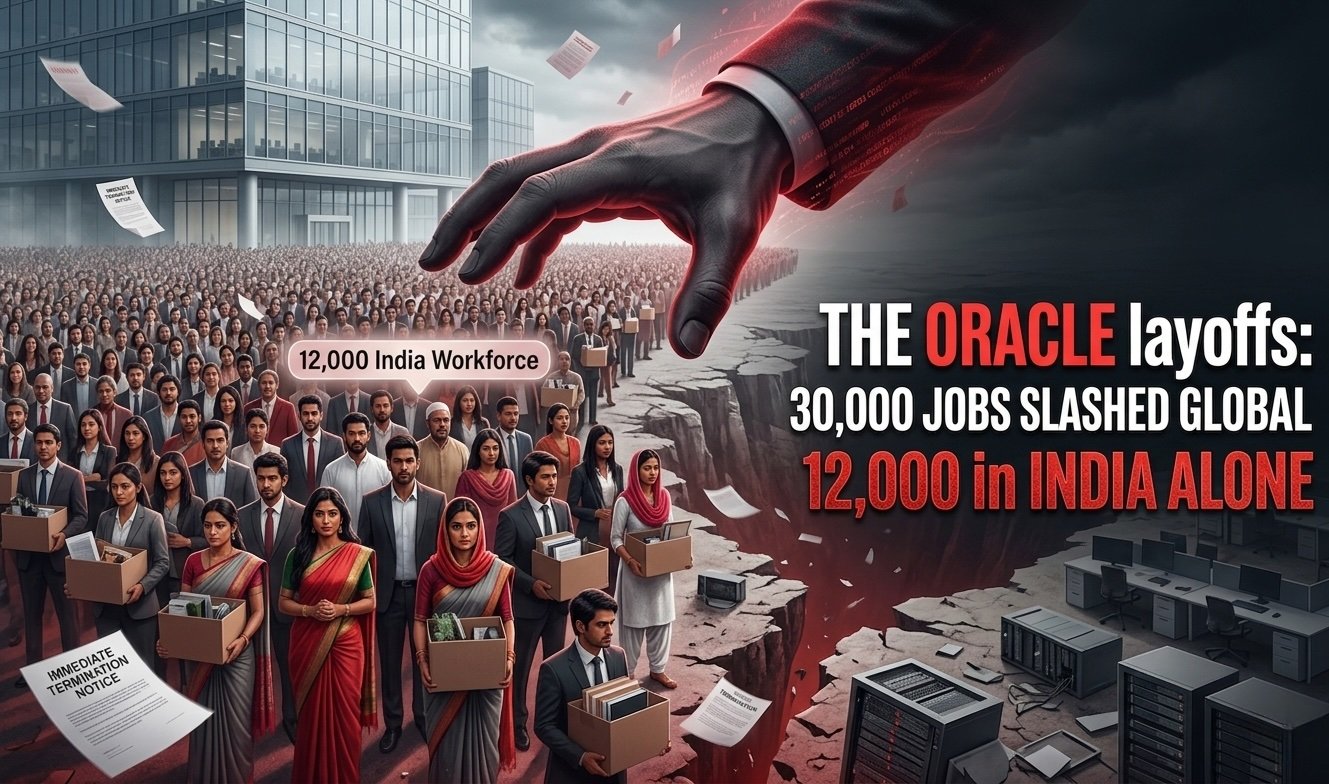
It was a Tuesday morning. Tens of thousands of people made their coffee, picked up their phones, and found an email waiting for them.
The sender was listed as “Oracle Leadership.” The message was five lines long. By the time they finished reading it, their careers at one of the most powerful technology companies on earth were already over. Their system access had been cut. Their Slack accounts were gone. The email told them to update their personal address because their company inbox was already being deactivated.
No phone call. No meeting with HR. No conversation with their manager. Just an email, sent just after 6 a.m., that ended everything before most of the world had even had breakfast.
What Oracle Actually Did
On 31 March 2026, Oracle executed what analysts are already calling the largest layoff in the company’s 48-year history. Estimates suggest the cuts affected between 20,000 and 30,000 employees, roughly 18% of Oracle’s global workforce of approximately 162,000 people. Workers in the United States, India, Canada, Mexico, and other regions all reported receiving the same termination notice at nearly the same hour, sent under the name “Oracle Leadership.” Rolling Out
There was no prior warning from HR or direct managers. The emails informed employees that their roles had been eliminated as part of a broader organisational change, and that the day of the email was their final working day. Access to company systems was cut immediately. TNW | Business
One of the first employees in Oracle’s history, someone who had worked there for over 40 years, was reportedly among those let go. Blind Forty years. Gone before 7 a.m. on a Tuesday.
People were sharing their termination emails on Reddit and LinkedIn in real time. Blind, the professional forum where tech workers talk anonymously, crashed multiple times throughout the morning as thousands of newly jobless employees flooded onto it trying to make sense of what had just happened.
Why Did Oracle Do This?
This is where the story stops being just shocking and starts being genuinely important.
Oracle is not a struggling company. Oracle posted a 95% jump in net income last quarter, reaching $6.13 billion, and its remaining performance obligations stood at $523 billion, up 433% year over year. This is not a company in revenue distress. TNW | Business
So why cut 30,000 people? The answer is AI.
Oracle has committed to an aggressive AI infrastructure buildout that requires an estimated $156 billion in capital spending. The layoffs are expected to free up $8 to $10 billion in cash flow, money going directly toward building AI data centres for clients including OpenAI, Meta, and Nvidia. TNW | Business
Oracle has taken on $58 billion in new debt over just two months, and its stock has lost more than half its value since its September 2025 peak. Boing Boing The company is not cutting people because it cannot afford them. It is cutting people because it has decided that AI infrastructure is worth more than they are.
That is the sentence worth sitting with for a moment.
Now Stop Thinking About Oracle. Think About Yourself.
Oracle made headlines. But the 30,000 people who woke up to that email were not abstract statistics. They were software engineers, project managers, database administrators, operations leads, and team heads. They were people who had annual reviews, career plans, mortgages, and colleagues they had worked alongside for years.
Oracle’s senior manager Michael Shepherd confirmed publicly on LinkedIn that the layoffs were not performance based, meaning high performers and recently promoted employees were let go alongside everyone else. INDmoney
It did not matter how good you were. It did not matter how long you had been there. When the decision was made at the top, the email went out to everyone equally.
So here is the honest question this story forces all of us to ask. How different is your situation, really?
More than half of workers globally say they are worried about losing their jobs to AI or automation in 2026, including one in ten who describe themselves as extremely worried. Resume-Now That anxiety is not irrational. It is a reasonable response to what companies like Oracle are openly telling the world they are doing.
The Roles Most at Risk Right Now
Most people assume AI will come for the simple, repetitive jobs first. The data says otherwise.
The workers most exposed to AI are not who most people picture. The most AI-exposed group earns 47% more on average and is nearly four times as likely to hold a graduate degree. That is the lawyer, the financial analyst, the software developer, not the warehouse worker. Fortune
AI may substitute for entry-level workers who rely on codified, textbook knowledge, while complementing experienced workers whose value comes from hard-earned judgment that AI cannot easily replicate. Dallas Fed If you are early in a white-collar career, that is genuinely uncomfortable to hear. But knowing it is better than not knowing it.
What You Can Actually Do About It
The Oracle story is alarming. But panic is the least useful response to it. Here is what actually matters.
The people who will be fine in the years ahead are not the ones who ignored AI. They are the ones who understood it early, learned to use it well, and built skills and visibility that no single email can take away overnight.
Candidates with AI skills are currently 8 to 15 percent more likely to be invited for a job interview across diverse occupations including graphic design, office administration, and software development. Workers with AI-related skills also command, on average, an advertised salary 23% higher than comparable candidates without those skills. World Economic Forum That is a bigger wage premium than a postgraduate degree right now.
For business owners, the lesson is slightly different but equally urgent. The Oracle story is a reminder that no job, no team, and no company structure is permanent. What is permanent is your relationship with your customers and how easily they can find you, trust you, and choose you when they are ready to spend.
A professional website does not call in sick. It does not receive a 6 a.m. email. It does not lose its access credentials. It works for your business every single hour of every day, building credibility and capturing leads whether you are in the office or not.
In March alone, more than 40,000 jobs were cut across the tech sector globally, with many firms explicitly connecting reductions to AI and automation. Tech industry observers say the wave is far from over. World Socialist Web Site
The world is reorganising itself around AI faster than most people expected. The question is not whether that affects you. It is whether you are building something that can withstand it.
The Bigger Picture
Every major technological shift in history produced the same wave of fear, followed eventually by adaptation. The spreadsheet replaced bookkeeping clerks and created an entire generation of financial analysts. The internet killed travel agents and built an entire economy of online businesses that did not exist before.
AI will do the same. The shape of work is changing. New roles are being created even as old ones disappear. But the transition period, the part we are living through right now, is genuinely difficult for real people in real jobs.
What happened at Oracle on Tuesday morning was not an anomaly. It was a signal. And the signals are worth paying attention to.
Your business deserves a digital foundation that works as hard as you do. Book your free consultation with Degitaldevs today at degitaldevs.com
Get in touch at contact@degitaldevs.com